
Jill Kerper Mora
A Transdisciplinary Knowledge Base
The knowledge base of educating multilingual learners (MEKB) is the product of collaboration between researchers and practitioners to generate knowledge about best practices. Empirical data serves to test theories that are foundational to instructional efficacy within particular school and classroom contexts for particular purposes. A metaphor for a knowledge base is the watershed of a river. (See Figure 1). Many tributaries flow into the river as it winds its way through the countryside. Each tributary contributes to the river’s mainstream, while together they comprise an ecosystem. If a tributary is blocked so its waters cannot reach the river, the force and flow of the river is diminished, potentially damaging the river’s ecosystem. The river in this metaphor is pedagogical knowledge base comprised of distinctive bodies of disciplinary knowledge for teaching (Shulman, 1987). We consider how the multiple academic disciplines that contribute to the knowledge base for teaching multilingual learners are like tributaries that sustain practitioners’ expertise and professionalism. Disciplinary knowledge empowers a teacher to engage in deep thinking about curriculum questions, such as what to teach and why with regard to the students’ characteristics, needs and experiential backgrounds. Johnson (2019) considers the knowledge base for language teacher education as a transdisciplinary framework that reflects distinctive, yet compatible theoretical perspectives that together bridge the theory-practice divide. The view of pedagogical content knowledge as transdisciplinary justifies teachers’ opposition to critics who attempt to invalidate certain methods of inquiry and empirical databases for educating multilingual students.
Mora, J. K. (2024). Reaffirming multilingual educators’ pedagogical knowledge base. Multilingual Educator, February(CABE 2024 Edition), 12-14.
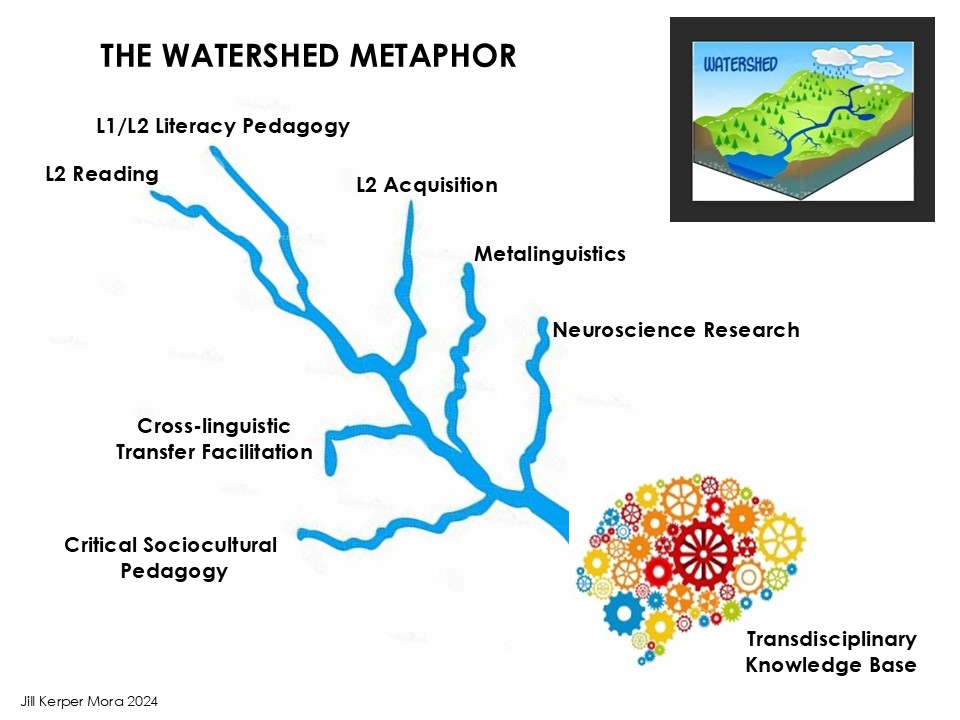
Figure 1: The Watershed Metaphor
Theoretical Orientation
Research into the characteristics of effective literacy teaching provides a perspective on how teachers interpret and integrate theoretical models of literacy instruction to promote high levels of student achievement. A valuable construct that expresses the operation of the transdisciplinary knowledge base is theoretical orientation (TO). DeFord (1985) developed a questionnaire, the Theoretical Orientation toward Reading Profile (TORP), that places teachers along a continuum of pedagogical perspectives toward reading instruction based on their response patterns. This study found that teachers of known TO who were observed during reading instruction exhibited response patterns on the questionnaire that were consistent and predictable in relation to their classroom teaching behaviors. The research on TO validates the notion that teachers’ planning and in-the-moment decision-making about literacy instruction within the context of their professional assignments are grounded in their interpretation of their pedagogical knowledge base. A coherent TO enables teachers to articulate a rationale for the choices of instructional approaches and formulate a “toolkit” of strategies and learning activities.
Taboada, et al. (2005) conducted a study of how teachers implemented constructivist reforms in the Mexico National Reading Program. We found that teachers demonstrated congruence with the meaning-making, constructivist theoretical model of the national curriculum in their instructional practices in first-grade classrooms. Systematic exploration of the role of teachers’ theoretical orientation in a mandated literacy program confirmed that congruence between a coherent knowledge base and teachers’ utilization of effective instructional approaches and strategies produces positive learning outcomes for students.
Click here for a Theoretical Orientation Research Bibliography.
Multilingual Learner Education Disciplinary Research
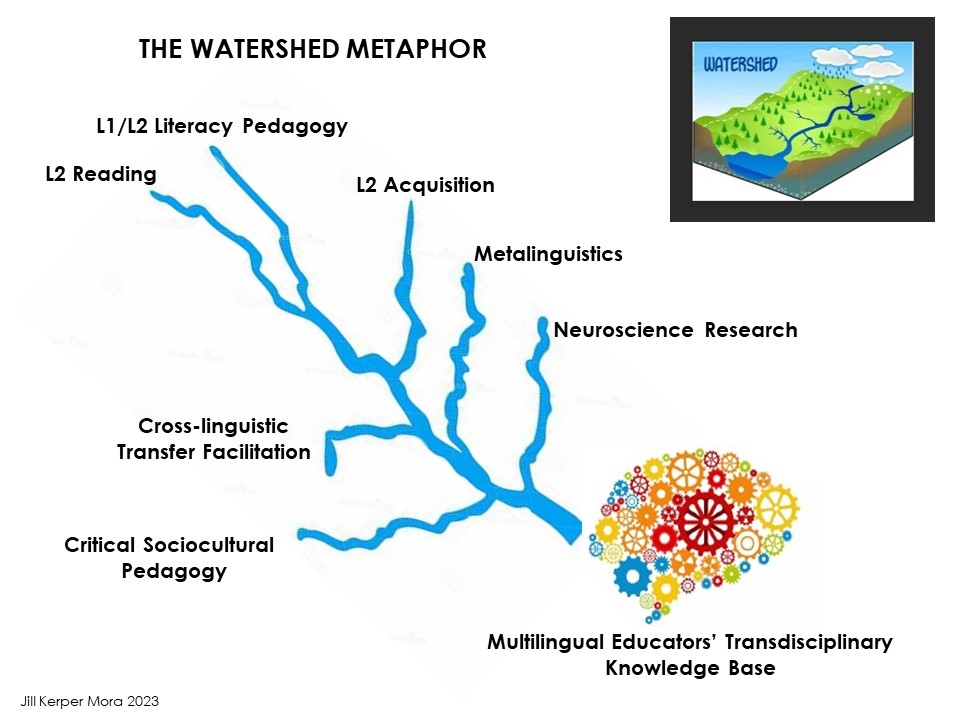
The transdisciplinary nature of the knowledge base for multilingual educators’ professional practice is demonstrated using the Watershed Metaphor. The tributaries identify the sources of empirical research that support specialized curriculum and instruction for emergent bilingual students. The metaphor illustrates how language and literacy methods and approaches are based on research that identifies principles that apply across languages while other aspects of literacy learning are language specific. Approaches to instruction target a specific orthography that reflects the features of a particular language. Consequently, a criterion for evaluating the legitimacy of research studies is population validity. This criterion determines the applicability of research findings to specific populations that may not share learning characteristics that permit research findings to be generalized to that population of students, such as multilingual learners. The fields of study that are entailed in teachers’ theoretical orientation toward literacy instruction for multilingual learners meet population validity criterion. Respect for population validity in research requires that biliteracy instruction be informed by research on monolingual speakers of both the languages of instruction (Noguerón-Liu, 2020).
Research in the field of second language acquisition (SLA) contributes a number of theoretical constructs to the MEKB. Learning a new, second, foreign or additional language (L2) may be simultaneous or sequential, depending on the linguistic and cultural circumstances of the emergent bilingual student. SLA research provides knowledge of a sequence of learning through developmental levels that enable teachers to assess L2 language proficiency’s correlation with variability in students’ outcomes in literacy learning. The reciprocity of L2 language and literacy learning is confirmed through research that disaggregates factors within the learner’s common underlying reservoir of cross-linguistic interdependence (Cummins, 2021). Accordingly, Krashen (2004) critiques the lack of population validity of research that does not provide a description of the literacy learning trajectories of emergent bilingual learners.
Click here for a module on Theories of Second Language Acquisition.
The knowledge base for literacy instruction for multilingual learners is further reinforced by investigations of L2 reading (Bernhardt, 1998). This field of inquiry is based on a multifactor theory that presupposes an interactive, multidimensional dynamic of literacy elements’ development along a continuum of L2 proficiency. Bernhardt attributes different error patterns (miscues) during oral reading performance in developing L2 literacy to readers’ risk-taking and to the increased potential for misusing and misunderstanding complex syntactic forms, which tend to decline as language proficiency increases. L2 reading research explores variables in text comprehension such as word recognition, vocabulary knowledge, syntax, phonology, and text structure through the perspective of language competencies as an integrative process. Miscue analysis assessments enable teachers to identify the interaction between students’ metalinguistic knowledge and their developing language proficiency by analyzing readers’ approximations or miscues in recognizing words based on their phono-graphemic and syntactic features. The operational hypothesis is that the language proficiency underlying cognitively demanding tasks, such as literacy and academic learning, is largely shared across languages, and therefore, linguistic competencies acquired in one language promote literacy development in another (Cummins, 2021).
Click here for a Bibliography of Research Studies on Miscue Analysis.
The sub-field of metalinguistics examines interlingual relationships to discern the shared and unique contributions of awareness of the operations of defined subsystems of language in reading development and performance. Ke, et al. (2023) conducted a meta-analysis of empirical studies that identify multiple direct and indirect paths that connect metalinguistic awareness, reading comprehension and vocabulary knowledge together as reading-related outcomes. These studies explain both shared metalinguistic awareness and language-specific metalinguistic awareness as empirical evidence of the extent of cross-linguistic transfer in literacy development. Koda’s Transfer Facilitation Model provides predictions on multiple factors that affect transfer of subskills in L2 reading and identifies conditions that promote cross-linguistic transfer.
Click here for a Bibliography of Research on Metalinguistics.
Neuroscience has provided insights into how the brain processes written text as graphic alphabetic representations of language. Through advanced fMRI and other neuroimaging technologies, neuroscientists can map regions of the brain that are activated during oral and silent reading of text in different languages (Dehaene, 2014). A limitation of neuroscience research is that the brain research technology is unable to discern neurological pathways of text processing to support arguments in favor or against some theoretical models of reading that are foundational to certain approaches to literacy instruction (Strauss, 2005). Consequently, multilingual educators must view claims that neuroscience supports or rejects certain instructional strategies with skepticism.
Click here for a Bibliography of Neuroscience Research on Literacy.
Click here for a Bibliography of Research on the Bilingual Brain.
The Watershed Metaphor for multilingual educators’ transdisciplinary knowledge base illustrates the concept of the river and its tributaries as an ecosystem. Critical sociocultural pedagogy is “…the anchor needed to connect the ideological with the pedagogical, programmatic, curricular, and evaluative dimensions for establishing culturally and linguistically equitable teaching and learning spaces.” (Alfaro, 2019: 195). Multilingual educators must possess critical consciousness and ideological clarity to exercise their agency through the application of the multiple streams of research-based pedagogical knowledge to address the characteristics and needs of multilingual learners. Ideological clarity enables teachers to implement instruction consistent with their theoretical orientation toward literacy effectively and equitably, even though mandated commercial literacy programs may not fully address the learning needs of their multilingual students.
Dual language programs are implemented to address the academic goals and objectives of a specific student population. As a basis for decision-making, the linguistic, cultural and academic characteristics of the students that the dual language program serves drive language education model selection, curriculum design and classroom instruction. Students’ linguistic and cultural characteristics vary according to multiple factors, including how recently the students’ families immigrated to the United States, home language practices, and parental and familial goals for heritage language preservation as well as integrative motivations for learning English.
Díaz and Flores (2001) propose that teachers act as sociocultural mediators when taking a critical perspective on literacy instruction for minority language learners:
We also argue that the teacher’s pedagogical knowledge of language (oral and written, first and second) development and learning guides him or her in organizing teaching-learning, mediating and assessing the children’s progress, too. And, since literacy is one of the educational yardsticks used to measure academic achievement, it becomes paramount that the teacher’s pedagogical knowledge, habitudes, beliefs about teaching-learning, development, culture, and expectations determine the sociocultural link between failure and success in schooling. The teacher as the sociocultural link or sociocultural mediator must deliberately mediate. (p. 33)
In conclusion, then, the goal of education should not be to recapitulate the inequities that exist in society, but rather to offer students opportunities to defeat the limitations placed on them by social status, home language, and cultural background. (p. 45)
Click here for a Bibliography of Research Studies on Sociocultural Pedagogy
Conclusion
The Watershed Metaphor represents a pedagogical knowledge base as a river of knowledge that guides the flow of water from many tributaries into one pathway. This imagery presumes that the contribution of the streams of knowledge are cumulative rather than substitutional. New knowledge does not delegitimatize or nullify previous knowledge, but rather, accumulated knowledge is the mainstream of our collective wisdom. Science of Reading advocates have invented the term “research-aligned” as a basis for arguing against the use of certain instructional approaches and strategies that they believe do not comfort to their criteria for effectiveness. This ignores the fact that pedagogical decision making is highly contextualized and student-population specific. Consequently, we must ask this question: To what research should teachers align the knowledge base that informs their theoretical orientation toward literacy instruction for multilingual learners? We run the risk of giving undue credibility to literacy education reformers who try to blame the problems of literacy achievement on the practitioners who are working daily to counter these problems.
We multilingual educators must challenge attempts to narrow our knowledge base of coherent theoretical constructs and valid empirical databases based on spurious claims that this research is untrustworthy. Teachers must reaffirm the value of the transdisciplinary research that shapes our theoretical orientation toward literacy instruction and, in turn, our pedagogical practices to ensure that all students gain access to the linguistic and cognitive benefits of their multilingual repertoires. We must demand access to undistorted science and relevant empirical research that enhances our expertise for educating multilingual learners.
References
Click here for 20 bibliographies of transdisciplinary research that informs the Pedagogical Knowledge Base for Multilingual Learners’ Literacy Education.
Alfaro, C. (2019). Preparing critically conscious dual-language teachers: Recognizing and interrupting dominant ideologies. Theory Into Practice, 58(2), 194-203.
Bernhardt, E. B. (1998). Reading development in a second language: Theoretical, empirical and classroom perspectives. Ablex.
Cummins, J. (2021). Rethinking the education of multilingual learners: A critical analysis of theoretical concepts. Multilingual Matters.
Díaz, E., & Flores, B. M. (2001). Teacher as sociocultural, sociohistorical mediator: Teaching to the potential. In M. d. l. L. Reyes (Ed.), The best for our children: Critical perspectives on literacy for Latino students (pp. 29-47). Teachers’ College Press.
DeFord, D. E. (1985). Validating the construct of theoretical orientation in reading instruction. Reading Research Quarterly, 20(3), 351-367.
Dehaene, S. (2014). El cerebro lector [The reading brain]. Siglo Veintiuno Editores.
Johnson, K. E. (2015). Reclaiming the relevance of L2 teacher education. The Modern Language Journal, 99(3), 515-528.
Ke, S. E., Zhang, D., & Koda, K. (2023). Metalinguistic awareness in second language reading development. Cambridge University Press.
Krashen, S. (2004). False claims about literacy development. Educational Leadership, 61(6), 18-21
Noguerón-Liu, S. (2020). Expanding the knowledge base in literacy instruction and assessment: Biliteracy and translanguaging perspectives from families, communities, and classrooms. Reading Research Quarterly, 55(S1), S307-S318.
Mora, J. K. (2023). To cue or not to cue: Is that the question? Language Magazine, June, 18-20.
Shulman, L. S. (1987). Knowledge and teaching: Foundations of the new reform. Harvard Educational Review, 57(1), 1-22.
Strauss, S. L. (2005). The linguistics, neurology, and politics of phonics: Silent “E” speaks out. Lawrence Erlbaum.
Taboada, D. S., Mora, J. K., & Vernon, S. (2005). Early literacy instruction in Mexico: Finding congruence between theory and practice. 55th National Reading Conference, Miami, FL.