Program Type 3 Biliteracy Materials Adoption Alert
Public Comment Alert
The California Instructional Quality Commission (IQC) will meet on Thursday, September 24, 2026, to consider the 2026 ELA/ELD Instructional Materials Follow-up Adoption, including Program Type 3 Basic Biliteracy materials. The California Department of Education states that members of the public are “highly encouraged” to submit written comments by noon on Thursday, September 17, 2026, so that commissioners have sufficient time to review them before the meeting. Comments may be submitted to iqc@cde.ca.gov. The September 17 date is therefore an important deadline for timely consideration, but it is not a cutoff for public participation; the September 24 meeting also provides opportunities for public comment by email, phone, or in person.
Colleagues with expertise in Spanish literacy, biliteracy, bilingual teacher education, and dual-language instruction are encouraged to review the Program Type 3 materials and supporting documentation. The IQC specifically requests that testimony concerning instructional materials identify the publisher, book or component, section, page number, or other specific location and address the materials’ alignment with California’s evaluation criteria. The Commission also encourages speakers to contribute new information rather than repeat comments already submitted.
For Program Type 3 materials, particularly useful comments may identify a specific Spanish-language feature or instructional example—such as syllable structure, lexical stress and accentuation, Spanish orthographic patterns, morphology, metalinguistic awareness, or cross-linguistic transfer—and ask where the program addresses it and how the 2026 review established alignment with the applicable Program Type 3 criteria. This approach can add concrete evidence to the public record without presuming in advance that a particular publisher has or has not adequately addressed the issue. Of particular relevance are Criteria 1.4 and 1.5 of the California Department of Education’s 2025 Guidance for the 2026 ELA/ELD Follow-up Adoption Evaluation Criteria Map.
Criterion 1.4
“Program 3 Basic Biliteracy programs are aligned with the CA CCSS for ELA and the CA ELD Standards with appropriate modifications for the non-English language.” (California Department of Education)
Criterion 1.5 — 2025 Guidance used for the 2026 follow-up adoption
“Education Code referenced in 2015 criterion 1.5 is no longer applicable. Instruction reflects current and confirmed research in English language development and dual language instruction, as appropriate to the program.” (California Department of Education)
Here is suggested language for a public comment regarding these two criteria:
Criteria 1.4 and 1.5 should be read together for Program Type 3 Basic Biliteracy materials. Criterion 1.4 requires “appropriate modifications for the non-English language,” while the updated Criterion 1.5 requires instruction to reflect “current and confirmed research in English language development and dual language instruction, as appropriate to the program.” Together, these criteria raise an important review question: What language-specific standards and research base were used to determine that the modifications for Spanish were appropriate and that the resulting Spanish literacy instruction reflected current and confirmed research in dual-language instruction?
CDE asks commenters, when possible, to include their first and last name, organizational affiliation, and agenda item number in the body of the email.
CDE September 24 IQC Meeting Notice and Agenda
Program Type 3 Evidence Repository
The resources below are provided to support informed examination of the 2026 Program Type 3 Basic Biliteracy materials. They bring together California standards and evaluation criteria, the Common Core en Español Linguistic Augmentation, Bilingual Teacher Performance Expectations, crosswalk analyses, and research resources related to Spanish literacy, biliteracy, metalinguistic development, and cross-linguistic transfer.
Common Core En Español with Bilingual Teacher Performance Expectations Crosswalk
Common Core en Español Linguistic Augmentation Research Base
Research-based review of Spanish instructional materials requires evidence from the substantial research base on Spanish literacy development and pedagogy, biliteracy, metalinguistic awareness, and cross-linguistic transfer—including research conducted in Spanish-speaking countries.
Spanish Literacy Research: A Bibliography
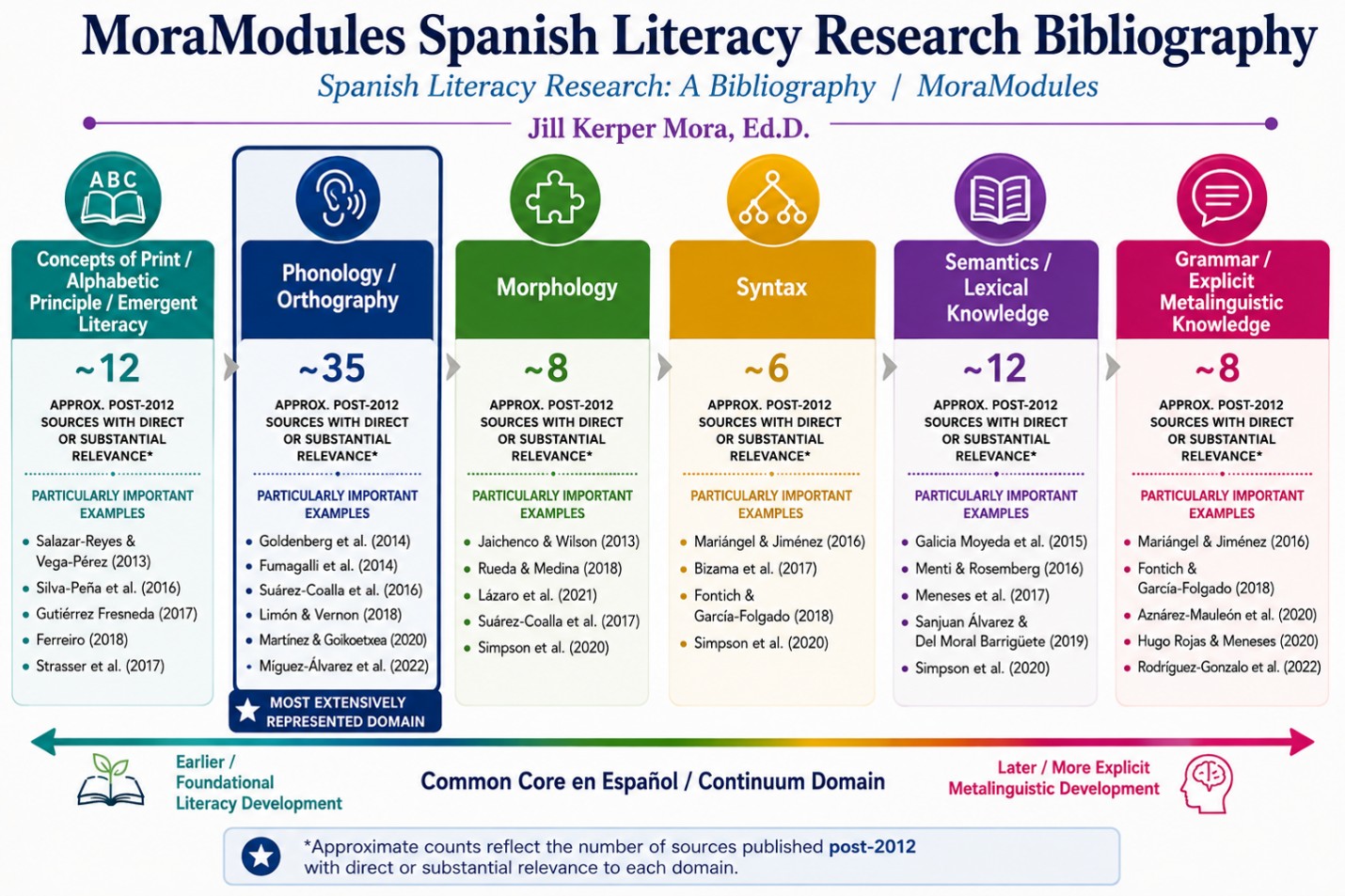
The MoraModules Spanish Literacy Research Bibliography documents a substantial body of empirical and scholarly research on the development and instruction of literacy in Spanish. The post-2012 research represented here spans six interrelated domains: concepts of print and emergent alphabetic literacy; phonology and orthography; morphology; syntax; semantics and lexical knowledge; and grammar and explicit metalinguistic knowledge. Phonology and orthography are especially extensively represented, with approximately 35 post-2012 sources of direct or substantial relevance, while newer research also documents the importance of morphology, syntax, vocabulary, grammar, and metalinguistic knowledge. Taken together, this literature demonstrates that Spanish literacy has a substantial language-specific research base extending well beyond phoneme–grapheme correspondences alone. It provides empirical evidence for understanding how the linguistic and orthographic characteristics of Spanish—including syllable structure, word formation, lexical stress, and other features of written Spanish—shape literacy development and instruction.
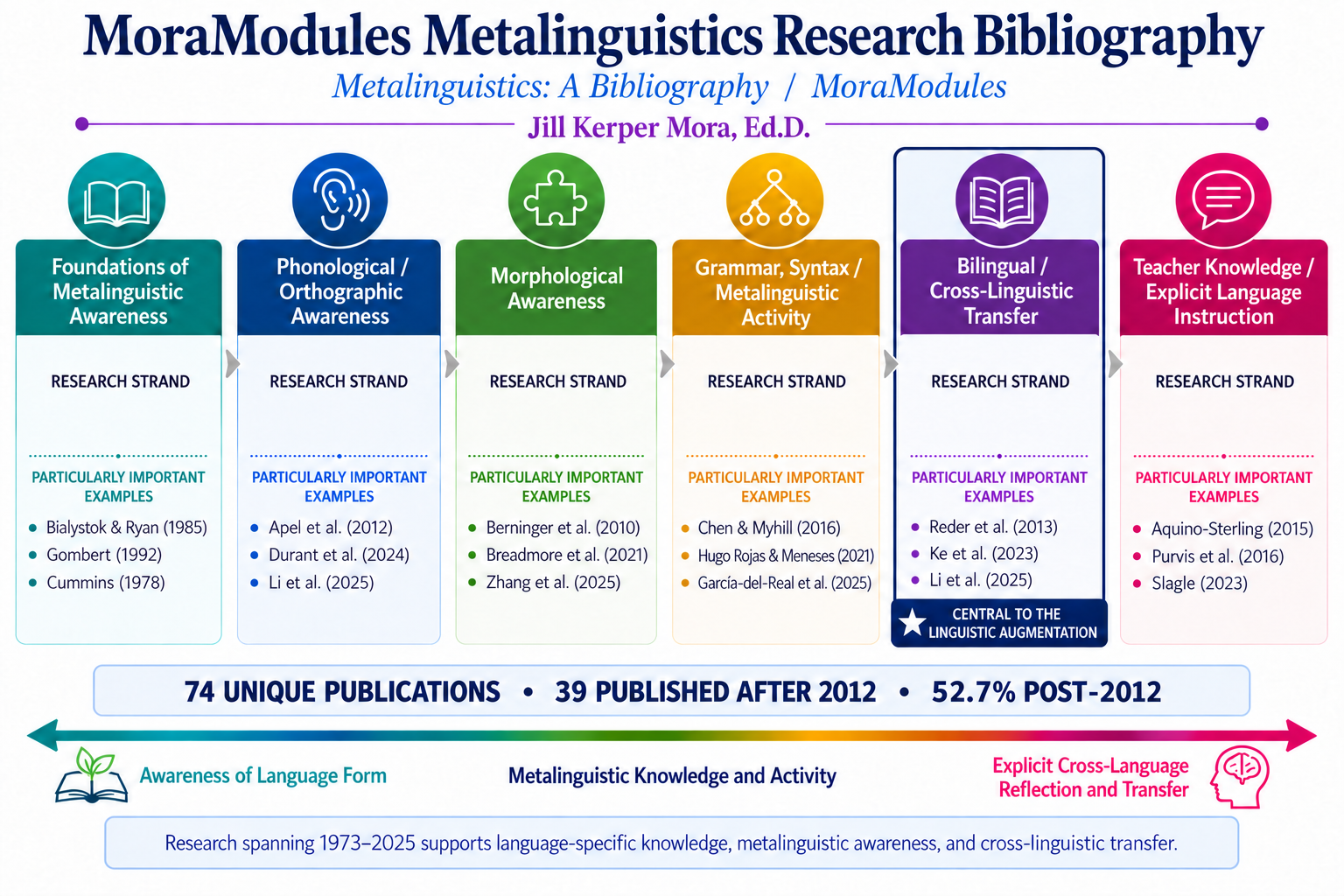
The MoraModules Metalinguistics Research Bibliography documents a complementary research tradition examining how learners develop increasingly explicit knowledge about language and use that knowledge in literacy and cross-linguistic learning. Its 74 unique publications span research from 1973 through 2025, with 39 publications (52.7%) published after 2012, demonstrating that this is both a longstanding and continuing field of inquiry. The literature encompasses foundations of metalinguistic awareness; phonological and orthographic awareness; morphological awareness; grammar, syntax, and metalinguistic activity; bilingual and cross-linguistic transfer; and teacher knowledge and explicit language instruction. Particularly important for Spanish-English biliteracy is the extensive research on learners’ ability to notice, compare, analyze, and transfer linguistic knowledge across languages. This research provides an important empirical foundation for the Common Core en Español Linguistic Augmentation and for instruction that develops language-specific knowledge while deliberately supporting metalinguistic awareness and cross-linguistic transfer.
Metalinguistics: A Bibliography
Together, these research collections demonstrate why “current and confirmed research” for Program Type 3 materials cannot be defined by English reading research functioning as the default scientific standard. A rigorous review must also draw upon the substantial and continuing research base on Spanish literacy development and pedagogy, metalinguistic awareness, biliteracy, and cross-linguistic transfer—including research conducted in Spanish-speaking contexts. Students learning to read and write in Spanish deserve instructional materials held to the same standards of scientific rigor, currency, and accountability as materials for English literacy instruction. Achieving that parity requires language-specific review—not identical review—because the linguistic knowledge required for literacy development differs across languages.
Transdisciplinary Research Bibliographies
The research foundations relevant to this discussion extend beyond Spanish literacy and metalinguistics alone. The broader MoraModules collection provides access to additional areas of scholarship that inform research-based practice in multilingual and bilingual education.
Dr. Mora’s 21 MoraModules Transdisciplinary Research Bibliographies extend this evidence base across multiple areas of scholarship relevant to multilingual and bilingual education. They reflect the premise that research on biliteracy instruction must draw from more than a single disciplinary tradition, bringing literacy research into conversation with linguistics, language development, biliteracy, assessment, pedagogy, teacher knowledge, and sociocultural research.
Dr. Mora’s 21 Transdisciplinary Research Bibliographies
Thank you for advocating for effective biliteracy instruction in California.
Jill Kerper Mora, Ed.D.